

Marketing
Your marketing and your CRM are the same system.
Campaigns, templates, segments, forms, website visitors and a lead score that moves with what people actually do. All of it reading the same pipeline your reps work in, so nothing syncs, nothing drifts and the score on a contact was computed from the deal rather than copied towards it.
14 days free. No credit card. Unlimited users.
- 14 days free
- No credit card
- Unlimited users
The problem with two systems
The marketing tool and the CRM disagree by Thursday.
Not because either is wrong. Because they are two databases with a pipe between them, and the pipe runs on a schedule.
What two systems cost you
You pay for the same person twice
A marketing contact in one tool and a CRM record in the other, on two bills that both grow with your list. Most teams discover this in year two, when the list is large and the leverage is gone.
The score is always a little old
A lead score computed in the marketing tool and pushed across is true as of the last sync. The rep opens the record after the prospect has already been on the pricing page twice.
Nobody can answer what marketing brought in
Attribution needs the campaign and the deal in the same place. Split them and the answer becomes a spreadsheet somebody rebuilds each quarter and nobody quite trusts.
What is in it
Six things, all reading the same records.
The suite
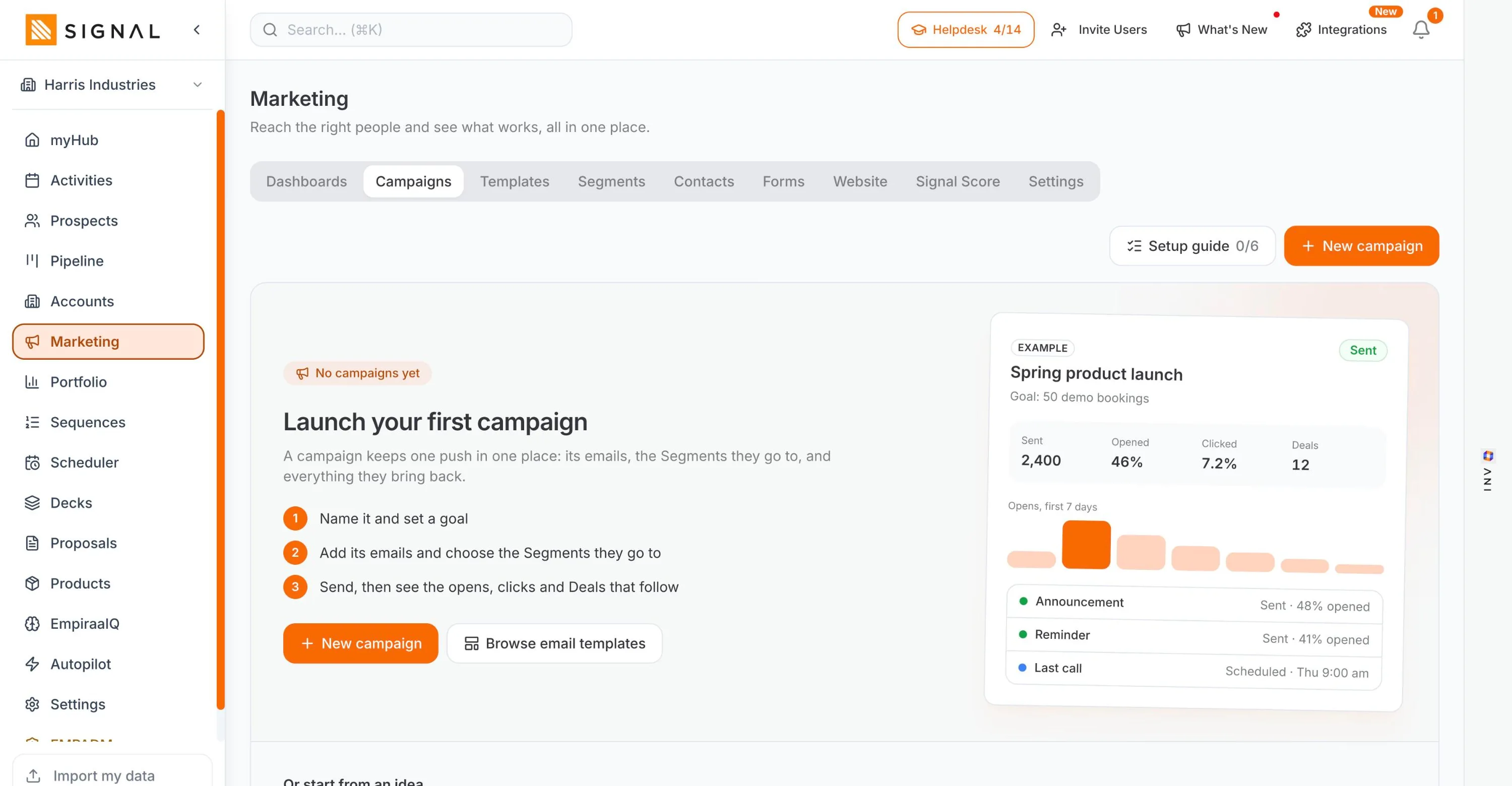
Campaigns, and the emails inside them
A campaign holds one push in one place: its emails, the segments they go to, and everything they bring back. Draft, scheduled, sending, sent. Each campaign carries a goal you set, so the report answers whether it worked rather than only what it did.- Emails, segments and results in one record
- A goal on the campaign, not just a send count
- Opens, clicks and the deals that followed
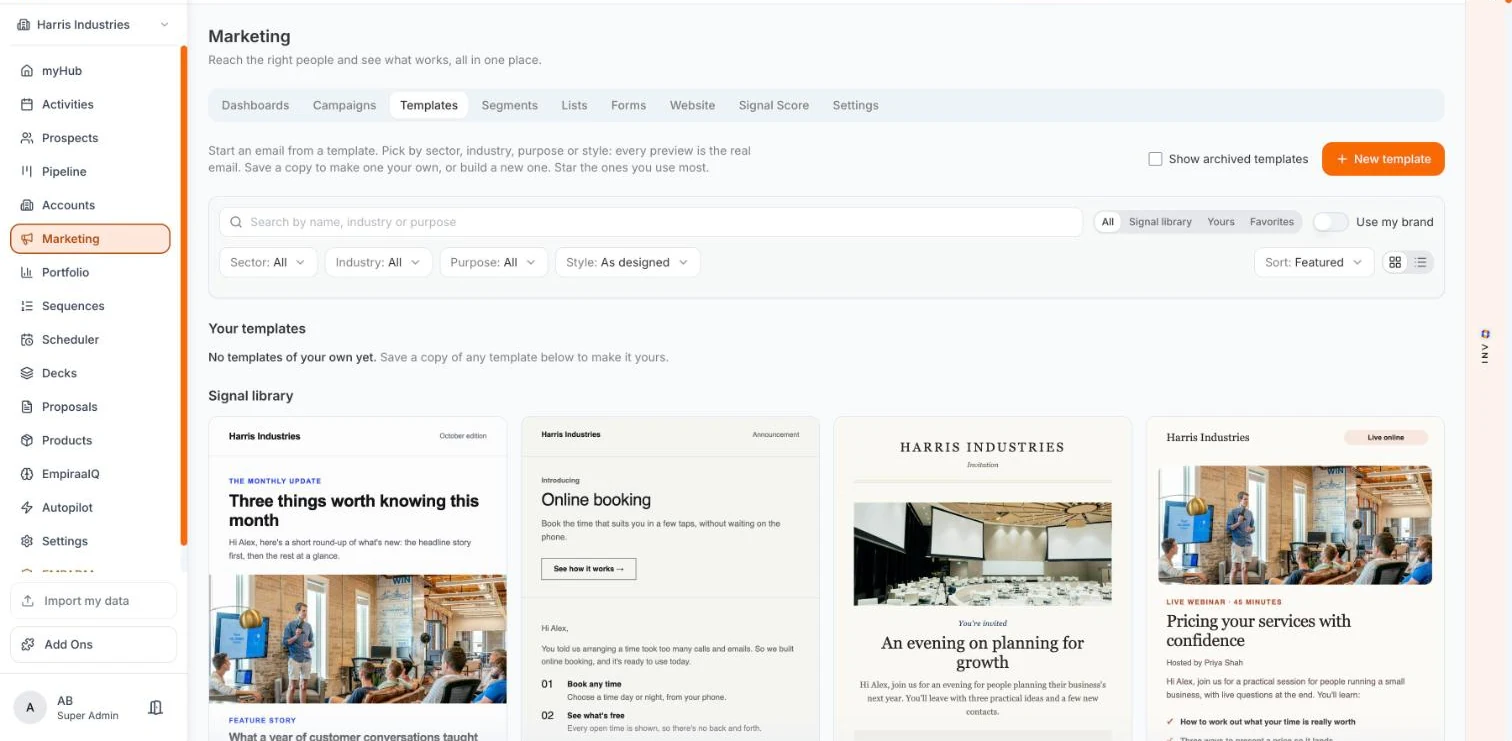
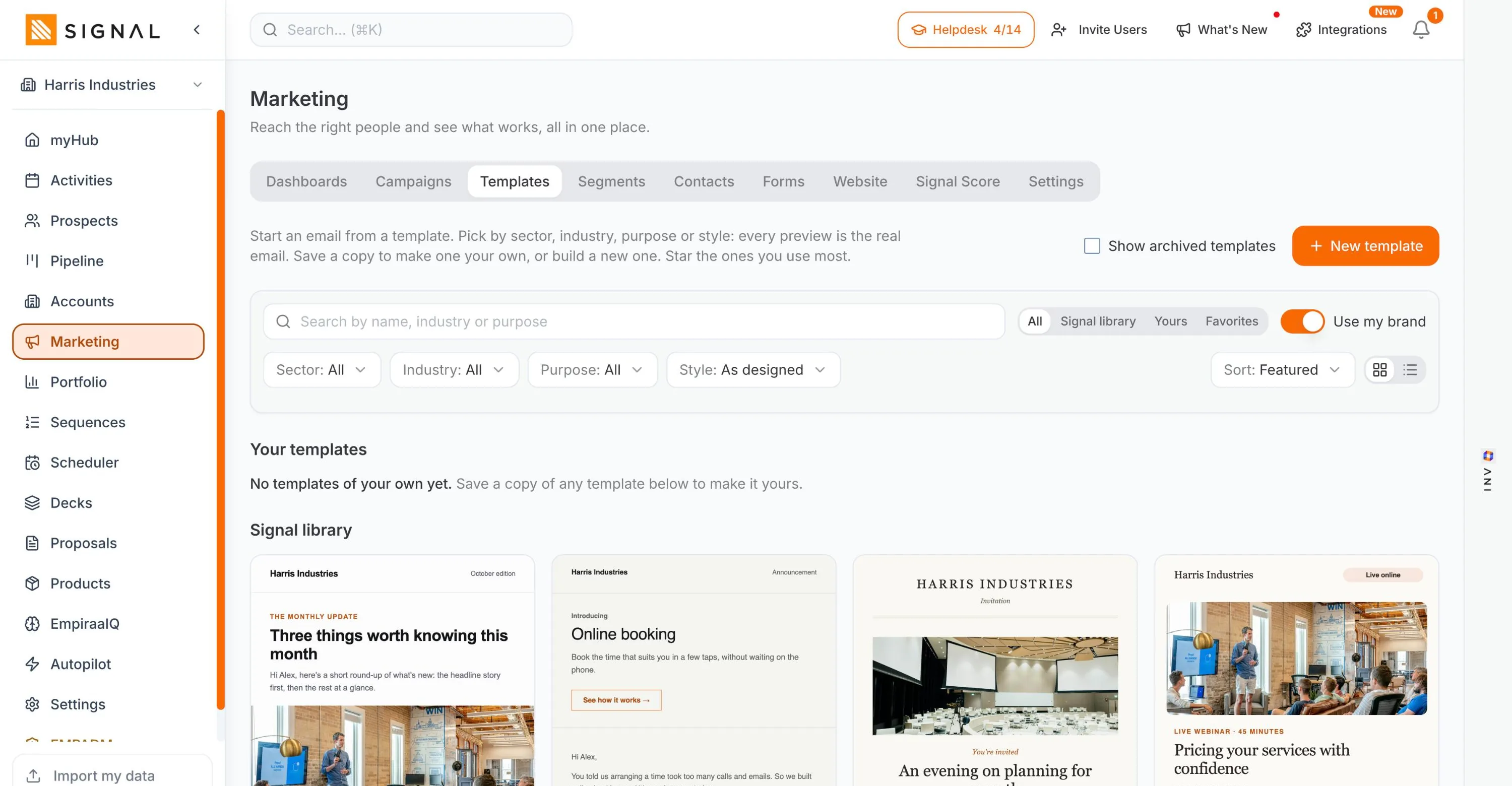
A template library that already looks like you
Around a hundred templates across thirty industries, filtered by sector, purpose and style. Turn on Use my brand and the whole library redraws in your colours, fonts and logo, so the starting point is already yours rather than something to spend a morning restyling.- Filter by sector, industry, purpose or style
- Use my brand restyles every library template at once
- Save a copy to make any of them your own
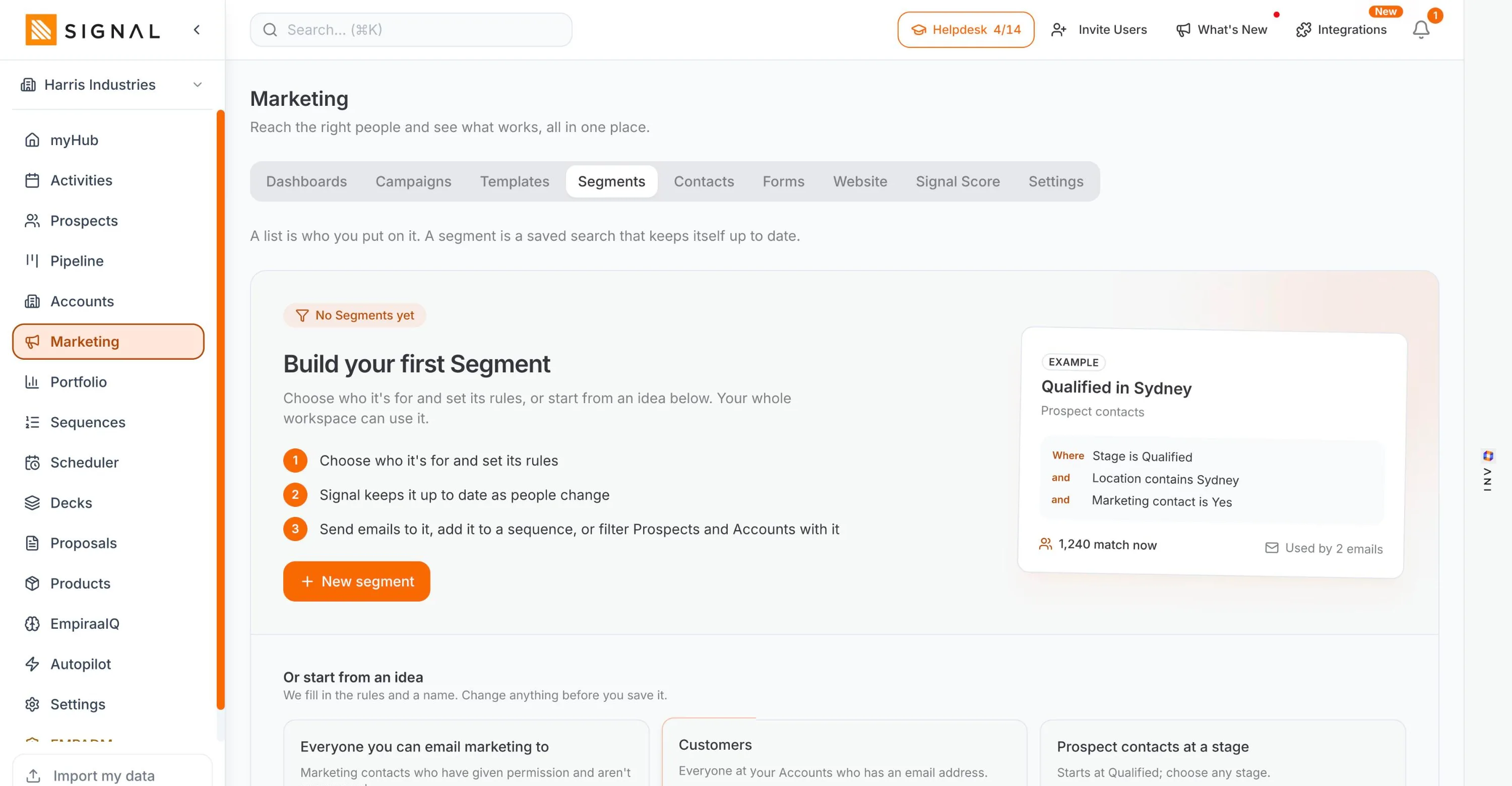
Segments that keep themselves right
A list is who you put on it. A segment is a saved search that stays current as people change, and your whole workspace can use it. Start from an idea such as everyone you can email marketing to, or Signal Score 70 and above, then adjust the rules.- Saved searches, not static exports
- Shared across the workspace
- Usable by an email, a sequence or a filter on Prospects
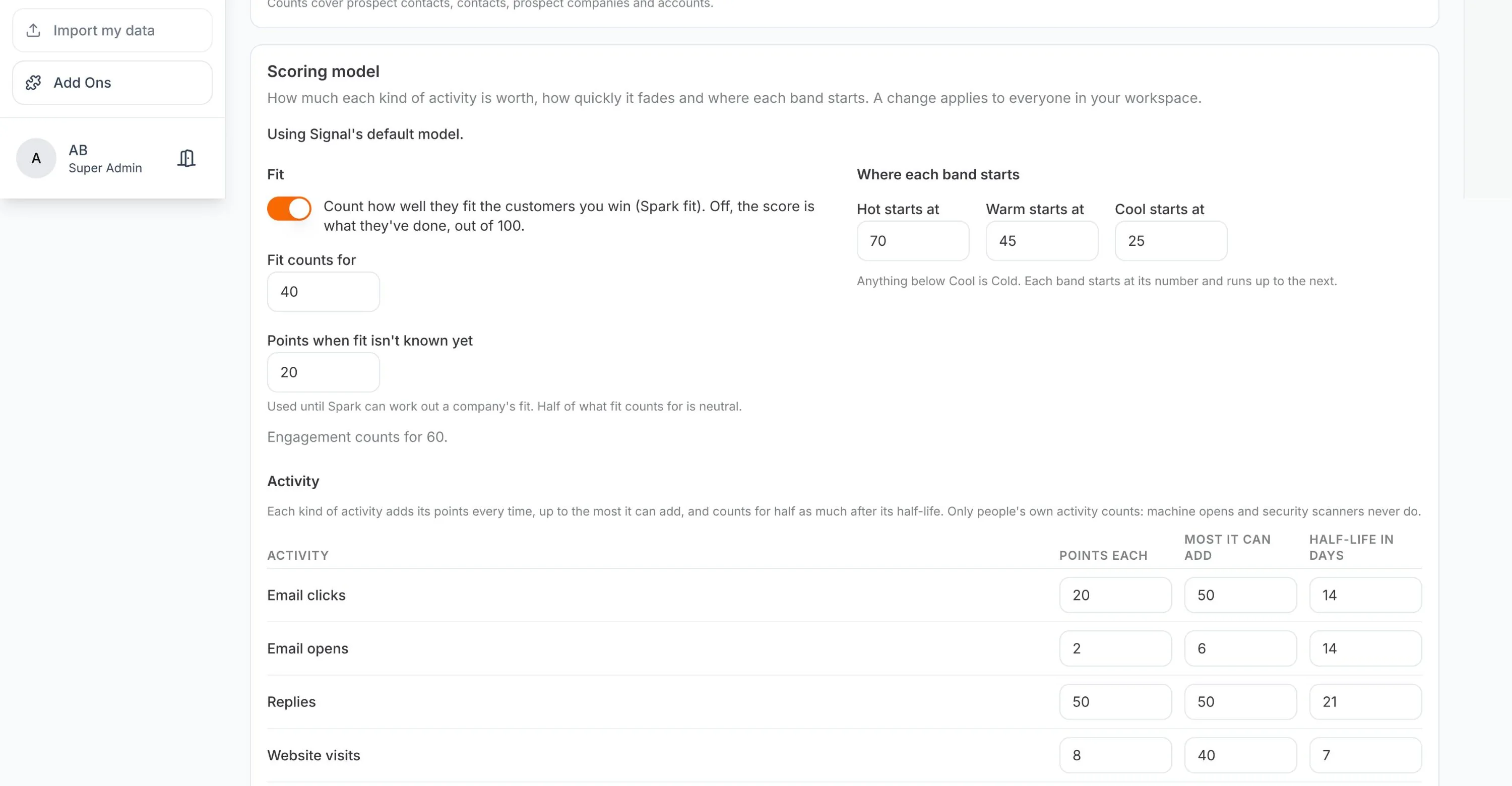
Signal Score, and you can see the model
A score out of 100 on every contact and company, combining how well they fit the customers you win with what they have done lately. Every number behind it is on one screen and every one of them is editable, down to the half-life on each kind of activity.- Points, a cap and a half-life per activity
- Hot, Warm, Cool and Cold thresholds you set
- Machine opens and security scanners never count
Forms, and the companies on your website
Forms with their own link, whose submissions become prospect contacts. And a one-line script that names the organisation behind a visit, usually inside a minute, matched by domain to the Account you already hold. It names companies rather than people, and only those running their own network, which is the honest limit on every tool of this kind.- Each submission can become a prospect contact
- 250 companies identified a month on Launch, with no credits to buy
- Cookieless, with GPC and Do Not Track honoured
- Visits kept for 13 months, page views kept for good
Attribution, back to the deal
Each deal’s value shared between the campaigns that touched the people on it, by day, by campaign and by channel, with how long those deals took to win. This dashboard is only possible because the pipeline is in the same database. It is the clearest argument on this page for not splitting the two.- Influenced pipeline and influenced revenue
- By campaign and by channel
- Days from deal made to deal won
Every plan has every feature. The difference between them is volume.
Explore Signal freeWhere ANI sits
The AI writing the email can see the CRM.
ANI drafts inside the email builder, next to Content, Sections and Style, rather than in a panel you paste out of. It is reading your ideal customer profile and the record, not a blank box.
ANI in marketing
Drafts the EDM in the builder
Ask for the email you want and it writes into the blocks, so there is nothing to copy across and nothing to reformat.
Writes the outreach too
The same assistant drafts sequence steps and polishes what you wrote, using the ICP so the draft knows who it is talking to.
You keep the final word
Every draft is yours to edit before anything sends. Nothing goes out because the assistant wrote it.
Questions
Questions about marketing in Signal
Is this a separate product from the CRM?
No. Marketing is a section of Signal, in the same workspace and the same database as your prospects, accounts and deals. There is no second login, no sync to configure and no separate marketing seat count, because every Signal plan includes unlimited users.
How does this compare to HubSpot Marketing Hub?
Honestly: HubSpot has things Signal does not, including landing pages, a CMS, social publishing and ads management. What Signal has that HubSpot cannot offer while Marketing Hub and Sales Hub are separate products is one system, so the lead score, the segments and the attribution read your live pipeline rather than syncing to it, and you are not billed per marketing contact on top of per seat.
What is the difference between a list and a segment?
A list is who you put on it, by hand or from a form, workflow or import. A segment is a saved search that keeps itself up to date as people change, and the whole workspace can use it. Signal also keeps three lists you cannot edit: unsubscribed, bounced and complained.
Do marketing emails count against my plan?
Yes, each plan includes a monthly marketing email allowance and top-up packs are available if you have a bigger month than usual. The allowance is on sends rather than on how many contacts you hold, so a large list you email occasionally does not cost more than a small one. See Signal pricing.
Can I bring my data across from HubSpot?
Yes, and the part worth knowing is that the import brings across everyone who has unsubscribed or bounced, not only the contacts. Starting a new tool without those suppressions is the fastest way to damage a sending domain in week one.
Can Signal tell me which companies visit my website?
Yes, and Signal does the identification itself, so there is nothing else to sign up for. The organisation behind a visit is named, usually inside a minute, and matched by domain to the Account or prospect company you already hold, so whoever it is assigned to can be alerted or an Autopilot workflow can start. Two limits worth knowing before you count on it: it names organisations rather than individual people, and only organisations that run their own network, so visitors on home Wi-Fi, mobile data or a VPN stay anonymous. How website visitor identification works.
Does the website tracking need a cookie banner?
The script writes no cookie and no local storage, and it honours Global Privacy Control and Do Not Track without being asked. You choose the consent mode per website: Required waits for a visitor to agree before anything is recorded, and Notice records unless they object.
What are the sample numbers on the screens?
Invented. Every screen on these pages comes from a demo workspace, and the campaign and segment cards are the product’s own worked examples, which Signal badges EXAMPLE and labels as not one of yours inside the app.

Weighing it against what you run now? Ask ANI and get a straight answer.
Run the marketing where the pipeline already is.
14 days free, no credit card, unlimited users. Bring your list across, suppressions and all.